Executive summary
Aura Coin ($AURA) is the utility token of Aura Protocol, a network that lets AI agents act on-chain the moment a smart contract event happens. Instead of agents watching the chain from outside and signing transactions with full wallet keys, Aura binds each agent workflow to a smart contract hook: when the hook fires, the workflow runs, inside limits the user set in advance, and pays for itself in $AURA.
The thesis in one line: hooks are the trigger, agents are the brain, $AURA is the fuel and the bond. Every automated run consumes $AURA, every agent operator must stake $AURA to be trusted with work, and part of every fee is burned.
| Item | Value |
|---|---|
| Token | Aura Coin ($AURA) |
| Max supply | 1,000,000,000 $AURA, fixed |
| Standard | ERC-20 on EVM-compatible chains |
| Core primitive | Smart contract hooks that trigger AI agent workflows |
| Fee burn | 20% of every workflow fee |
| Agent operators | Must stake $AURA; slashed for faulty or malicious runs |
| Governance | Aura DAO, voting with staked $AURA |
The problem
AI agents can already decide what to do on-chain; what they lack is a safe, cheap and verifiable way to act at the right moment. Today an on-chain agent is usually a bot on a server: it polls the chain, guesses when to move, and signs with a key that can do anything.
Late by design. Polling off-chain means the agent reacts after the event, often a block or more behind, and loses to faster bots.
Too much power. The agent holds a hot wallet key with no spending limit. One bad prompt, bug or leaked key can drain the wallet.
No proof. Users cannot check what the agent saw, what it decided, or why. A failed run leaves no accountable party.
Wasted cost. Bots pay for servers and RPC calls around the clock, even when nothing happens.
Fragmented. Every team rebuilds the same trigger, wallet and monitoring plumbing for each new agent.
The result: automation that should be routine, such as rebalancing a pool, protecting a loan or reinvesting yield, stays manual, risky or limited to a few teams with large infrastructure budgets.
The solution: Aura Hooks
Aura moves the trigger on-chain. A hook is a small piece of smart contract logic that runs at a fixed point in another contract's life cycle, for example before or after a swap in a liquidity pool, when a loan crosses a health threshold, or when a vault receives a deposit. Aura turns each hook into a starting gun for an AI agent workflow.
A workflow, called an Aura, has four parts:
Trigger: the hook it listens to, such as afterSwap on a given pool.
Condition: a cheap on-chain check that decides whether the run is worth paying for, such as "price moved more than 2%".
Agent: the AI model or strategy that decides what to do, run by a staked operator in the Executor Network.
Policy: hard limits the agent cannot break, such as maximum spend per run, allowed contracts, allowed tokens and a daily cap. Policies are enforced by the user's smart account, not by trust.
Three design choices set Aura apart from bots:
Event-native. Agents start in the same block as the event, with no polling.
Permission-scoped. Agents act through session keys bound to a policy, never through the user's master key.
Accountable. Every run leaves a receipt on-chain, and operators who break the rules lose part of their $AURA stake.
Architecture
A single run moves through six steps, and the user's funds are only touched after the policy check passes.
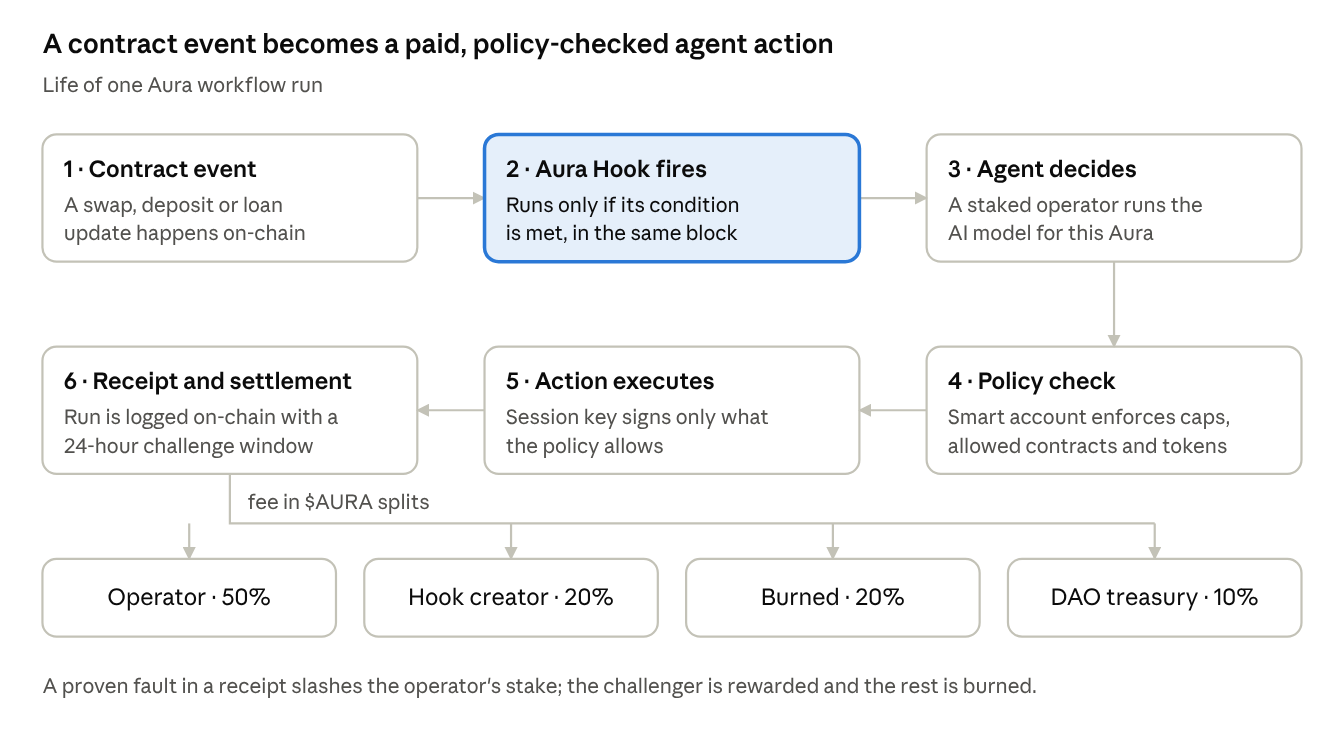
The hook and the condition run inside the triggering transaction, so a run that is not needed costs almost nothing. The agent's decision happens off-chain with an operator, but the action and its receipt land on-chain, where the policy and the challenge window keep the operator honest.
$AURA token utility
$AURA has five jobs in the network, and each one creates demand that grows with usage rather than with hype.
Gas for automation. Every workflow run pays a fee in $AURA. Users who prefer to pay in ETH or stablecoins can, but the fee is swapped into $AURA through a protocol hook before it is distributed.
Operator bond. Agent operators must stake $AURA to receive work. More stake and a better track record mean more jobs; faulty or malicious runs are slashed.
Hook creator royalties. Developers who publish hooks and workflow templates earn a share of every run that uses them, paid in $AURA.
Governance. Staked $AURA votes on fee levels, the burn rate, hook allowlists and treasury spending.
Priority and discounts. Users who stake $AURA get lower fees and priority execution when the network is busy.
Fee split per workflow run
| Recipient | Share | Purpose |
|---|---|---|
| Agent operator | 50% | Pays for compute and the risk of the stake |
| Hook / template creator | 20% | Rewards the builders who bring usage |
| Burned | 20% | Removed from supply permanently |
| DAO treasury | 10% | Funds audits, grants and growth |
Tokenomics
The supply is fixed at 1,000,000,000 $AURA, with no minting function after deployment. About 17% (170,000,000) circulates at the token generation event (TGE); the rest unlocks over six years, and the largest single bucket goes to the people who run and use the network.
| Allocation | Share | Amount ($AURA) | Unlocked at TGE | Vesting after TGE |
|---|---|---|---|---|
| Ecosystem & agent rewards | 30% | 300,000,000 | 15,000,000 | Linear over 72 months, paid to operators, creators and active users |
| Team | 15% | 150,000,000 | 0 | 12-month cliff, then linear over 36 months |
| DAO treasury | 15% | 150,000,000 | 15,000,000 | Linear over 48 months, spent only by DAO vote |
| Early investors | 13% | 130,000,000 | 0 | 6-month cliff, then linear over 24 months |
| Community & airdrop | 12% | 120,000,000 | 40,000,000 | Linear over 18 months through quests, testnet and referral programs |
| Liquidity & market making | 10% | 100,000,000 | 100,000,000 | Fully unlocked to seed DEX and CEX liquidity |
| Advisors | 5% | 50,000,000 | 0 | 12-month cliff, then linear over 24 months |
| Total | 100% | 1,000,000,000 | 170,000,000 |
Unlock schedule
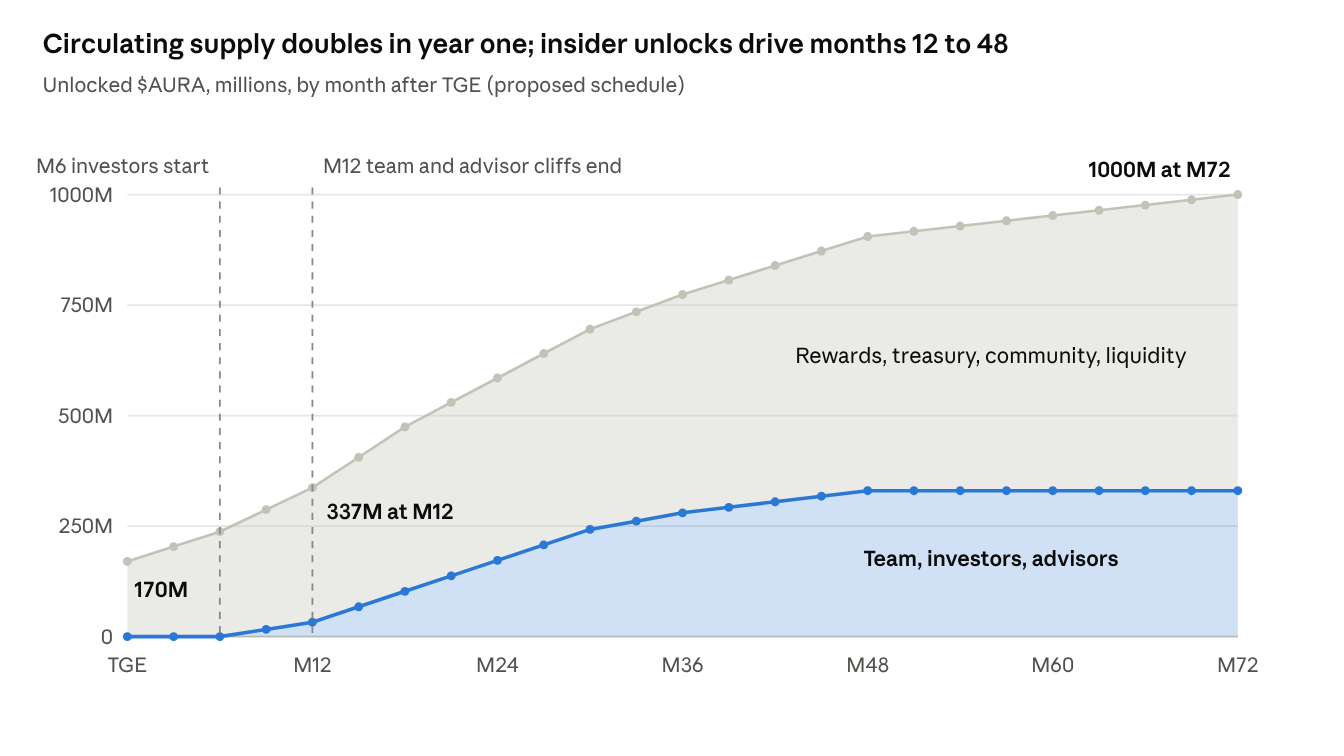
Insider buckets unlock nothing before month 6 and are fully vested by month 48; after that, only rewards and the treasury still add supply.
Burn and emissions
Rewards emit about 47.5 million $AURA a year. Because 20% of every workflow fee is burned, network rewards become net-neutral once yearly fees reach about 237.5 million $AURA (47.5M ÷ 20%). Above that level, usage removes more $AURA than rewards add.
Analyst view: where value accrues
$AURA captures value only if workflows actually run; the design links token demand to usage through three loops, and the one to watch is fee volume against unlocks.
Loop 1: usage burns supply. Each run burns 20% of its fee. Burn scales with the number of hooks live and how often they fire, not with token price.
Loop 2: work locks supply. Operators need stake to win jobs. As workflow volume grows, operators compete for it by staking more, which takes $AURA out of circulation. A healthy target is a staking ratio above 30% of circulating supply.
Loop 3: creators pull in users. A 20% royalty gives hook developers a reason to build and market templates, and each popular template brings recurring runs, not one-off trades.
What to track
| Metric | Why it matters | Healthy signal |
|---|---|---|
| Active hooks | Breadth of integrations | Steady growth across several protocols, not one |
| Workflow runs per day | Direct driver of fees and burn | Rising faster than new token unlocks |
| Yearly fees in $AURA | Burn vs emissions | Above about 237.5M $AURA, burn outpaces rewards |
| Staking ratio | Supply locked by operators | Above 30% of circulating supply |
| Top-10 holder share | Concentration risk | Falling after each unlock cliff |
Key dates for supply
The two pressure points are month 6, when early investors start unlocking, and month 12, when team and advisor cliffs end in the same month. Circulating supply roughly doubles from 17% at TGE to about 34% at month 12. Usage metrics should be strong before month 12 to absorb that supply.
Use cases
Any on-chain event that today needs a person or a bot to react can become an Aura. Six examples show the range:
| Aura | Hook that triggers it | What the agent does | Policy that limits it |
|---|---|---|---|
| Smart LP rebalancer | afterSwap on a liquidity pool | Moves the LP range when price leaves it, choosing the new range with a volatility model | Only this pool; max 1 rebalance per hour |
| Loan guardian | Health factor below 1.2 on a lending market | Repays part of the loan or adds collateral before liquidation | Spend cap per day; only the user's own position |
| Yield compounder | Vault deposit or reward claim | Claims rewards and reinvests in the best-yielding allowed vault | Whitelisted vaults only |
| Treasury guard | Large transfer out of a DAO treasury | Scores the transfer for risk and pauses it for review if flagged | Can pause, cannot move funds |
| Intent trader | User-signed limit order reaches a price on a pool | Routes and splits the order to reduce slippage and MEV | Max slippage and max size set by the user |
| Agent-to-agent payments | One agent finishes a task and posts a result | Pays the next agent in the chain in $AURA when the result is verified | Budget per task chain |
Roadmap
Aura is in Phase 1; each later phase opens only when the gate before it is passed, not on a fixed calendar.
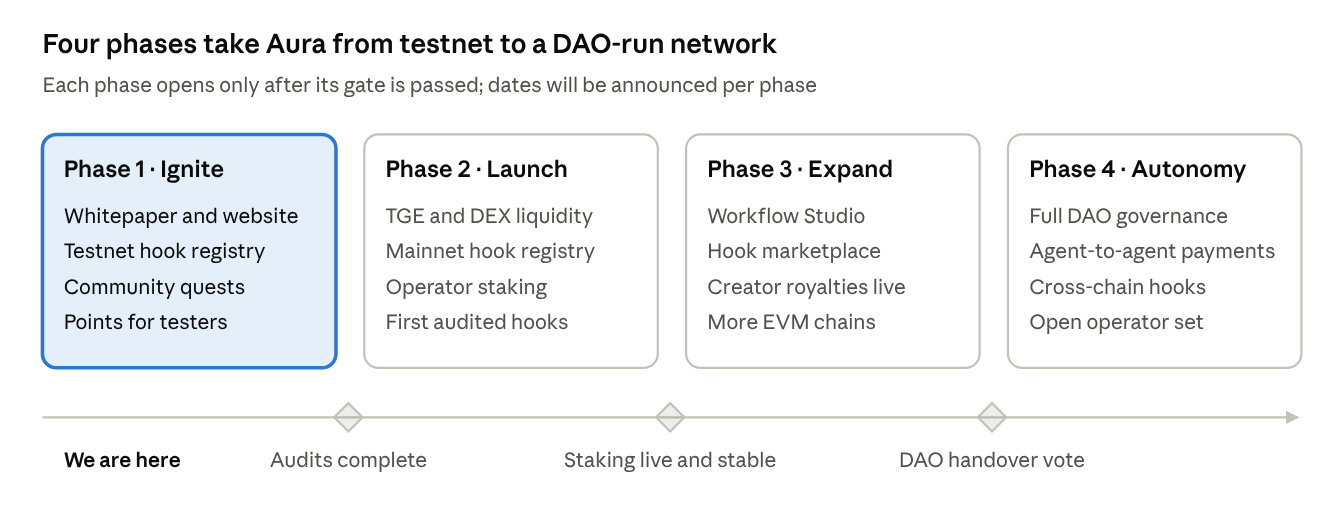
Gating phases on audits and live staking, rather than dates, lowers the risk of shipping hooks before they are safe.
Governance and security
Aura DAO controls the protocol's dials, and staked $AURA is the only way to vote.
| Step | Rule |
|---|---|
| Propose | Requires 5,000,000 staked $AURA (0.5% of supply) |
| Vote | Lasts 5 days; at least 4% of circulating supply must take part |
| Execute | Passed proposals run after a 48-hour timelock |
The DAO sets fee levels, the burn rate, the fee split, which hooks are allowlisted, and treasury spending.
Security model
Policies are enforced on-chain. An agent can only act through a session key scoped to the user's policy. A prompt injection or a model error cannot exceed the spend cap or touch other contracts.
Execution receipts. Each run writes the trigger, the inputs hash, the decision and the result on-chain. A 24-hour challenge window lets anyone dispute a run.
Slashing. Operators who break a policy, submit a false receipt or go offline repeatedly lose part of their stake. Slashed $AURA is split between the challenger and the burn.
Hook allowlist and circuit breakers. New hooks pass review before they can attach to major pools, and the DAO can pause a hook that misbehaves.
Audits and bug bounty. Independent audits of the hook contracts and policy accounts before mainnet, plus a public bug bounty paid in $AURA.
Risks
The biggest risk is that usage arrives slower than unlocks; the others are technical and competitive.
| Risk | What could happen | How the design responds |
|---|---|---|
| Unlock overhang | Supply roughly doubles in the first 12 months while fee volume is still small | Cliffs on team, investors and advisors; DAO can raise the burn rate |
| Hook contract bugs | A flaw in a hook or policy account could lock or lose user funds | Audits, allowlist for new hooks, DAO pause switch |
| Agent errors and prompt injection | A model makes a bad call or is tricked by crafted data | On-chain policy caps limit the damage per run; slashing makes operators careful |
| MEV and front-running | Searchers copy or sandwich agent actions | Private order flow and slippage limits in each policy |
| Competition | Other agent networks and keeper networks target the same jobs | Hook-native triggers and creator royalties as the moat; must be proven in usage |
| Regulation | Rules on tokens or automated trading change by country | Utility-first design; legal review before TGE in each launch market |
| Concentration | A few holders or operators control votes or most jobs | Stake caps per operator; watch top-10 holder share after each cliff |
Disclaimer
This document describes the planned design and direction of Aura Protocol and the $AURA token. It is not investment advice, a solicitation, or an offer of securities. Allocations, vesting, fee splits, governance parameters and timelines are proposals and may change before or after launch. Crypto assets are volatile and you can lose all of your investment; do your own research and consult a licensed advisor.